Webinar
Events
-
-
Avoiding Metastability in Hardware Software Interface (HSI) using CDC Techniques
Various IP blocks within an SoC are often required to work in different clock domains in order to satisfy the power constraints. Clock domain crossing (CDC) challenges faced by design engineers include: - Speed and power requirements lead to designs with multiple asynchronous clock domains on different I/O interfaces and data being transferred from one…
-
Solve EM Fields and Forces in PCBs for Consumer Electronics
This webinar will demonstrate how Ansys tools can improve PCB designs for higher performance and reliability. Ansys Maxwell simulates low-frequency (LF) EM fields to identify potential EMI/EMC issues for shielding and grounding purposes. Engineers can also predict electric currents distributed throughout the PCB power traces and study the EM forces generated by the magnetic field…
-

RTL-to-GDSII Flow for ASIC Design Using Cadence Tools
Would you like to know how to design a complete chip using the RTL-to-GDSII Flow? In this free technical Training Webinar with Application Engineer Sai Srinivas Pamula, we’ll teach you the essential steps in the RTL-to-GDSII design flow using a wide variety of industry-leading Cadence tools—such as the Xcelium Logic Simulator, Modus DFT Software Solution,…
-

Accelerating New Product Introduction with Integrated End-to-End Analytics
Are you seeking to achieve dramatic gains in product time to market? This webinar will explore the combined solution of proteanTecs deep data analytics solutions and the PDF Solutions Exensio platform for rapid NPI. This 30-minute program will include a presentation and a LIVE DEMO of the integration of PDF Solutions' Exensio platform and proteanTecs' deep data analytics…
-
CMOS Circuit Techniques for Wireline Transmitters Part III
Synopsys Webinar – Part III In this 3-part Synopsys webinar series, we will present how hyperscale data centers are going through a paradigm shift with the advent of technologies like Artificial Intelligence (AI) and edge compute requiring hyperscale data centers to support exponential growth of data volume. This volume of network traffic demands an increase…
-

Automated Power Intent Management Pre-synthesis for Large SoC Designs
With increasing chip design complexity, power intent management is becoming a requirement by chip designers. Power intent (UPF) databases are getting more and more complex and difficult to handle by designers without a reasonable level of automation. Query UPF databases, UPF creation and assembly are among the key capabilities to ease the implementation for complex…
-
Debugging SystemC with GDB
Webinar Overview: This webinar explores debugging SystemC code with basic tools, including issues and strategies to make improvements. A large portion of the webinar includes a demonstration of a small design. Topics include single-stepping without getting lost and obtaining information about SystemC simulation status. The session concludes with ideas on how to simplify debugging and…
-
-

Speed Up Your Electronic Component Design with HPC
About this Webinar Electronic components design and their integration on PCBs involve complex simulations to predict EM fields and forces accurately. These simulations can be computationally intensive and time-consuming. High-Performance Computing (HPC) capability built into Ansys Maxwell core technology significantly accelerates the electronic component design process, enabling quick iteration, optimization, and validation. The ECAD capability…
-
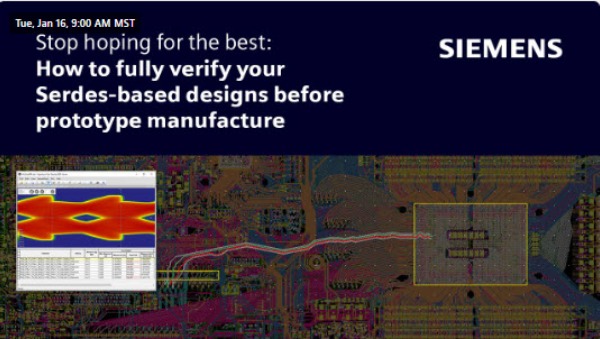
PCB Design Best Practices: How to fully verify your Serdes-based designs before prototype manufacture
“Right first time” is a goal we all aspire to, but how often does it really happen? Even when we follow layout rules as closely as possible, problems creep into the layout that cause issues during lab testing and result in costly, time-consuming respins. Join our expert presenter Todd Westerhoff in this LinkedIn Live…
-

Meet Advanced IC Package Design Schedule Challenges with In-Design Analysis
The heterogeneous integration of chips/chiplets has added significant complexity to the IC package design process, further compressing schedules for many design teams. Design teams must work more efficiently to meet quality and performance goals while maintaining schedule milestones. One way to improve efficiency is to shift signal and power integrity (SI/PI) analysis to earlier in…
-

Verisium SimAI: Coverage Gaps Meet Their Match
Every project has some areas that seem impossible to cover. Various factors can cause these nearly impossible-to-hit coverage gaps, including technical complexity, lack of resources, and shifting requirements. In constrained random environments, simply running more random seeds may not always address these coverage gaps effectively. Overcoming these gaps requires creativity, persistence, and technical expertise. A…
-
Comprehensive PCIe Verification Solution for bleeding edge and mission critical SoC & IP Designs
Applications such as Data Centers, High-Performance computing (HPC), artificial intelligence/machine learning (AI/ML), cloud computing, military, and aerospace, automotive, etc. are all extremely Bandwidth-hungry. To cater to such high demands of high speeds and bandwidth requires a breakthrough that HPC SoCs are constantly facing. High speed interfaces like PCI Express® (PCIe®) 5.0 and 6.0 show promising…