Webinar
Events
-
-

Run Ansys HFSS in the Cloud with AWS to Boost Simulation
About This Webinar Engineers worldwide use Ansys HFSS software to design high-frequency, high-speed electronics found in communications systems, advanced driver assistance systems (ADAS), satellites, and internet-of-things (IoT) products. Ansys HFSS is a 3D electromagnetic (EM) simulation software for designing and simulating high-frequency electronic products such as antennas, antenna arrays, RF or microwave components, high-speed interconnects,…
-

Driving Forward with UWB Radar: Enhancing Child Safety in Automotive
Fueled by the recent adoption by leading smartphone brands, the UWB wireless technology is enjoying an explosive growth in market interest and applications. In automotive, UWB is already the de-facto choice for Digital Keys in the premium segment. The deployment of UWB anchor points in modern car creates a cost-effective platform for offering advanced in-cabin radar,…
-
Verify Your SoC Design Efficiently from Planning to Coverage Closure using Synopsys Verification Family
Verifying an SoC is an extremely complex process that requires agile turnaround, constant control feedback, and flexibility to adapt to evolving project needs. Coverage is an efficient metric for the number of potential bugs found and needs to be tracked at each stage of the project. The verification process starts from defining the verification goals,…
-

Microelectronics Design Security: Better with Formal Methods
Whether you are developing Systems-on-Chip (SoCs) for mobile and wearables, automotive, aerospace, defense, data centers, or entertainment, securing your proprietary data and customers’ information is critical to your company’s long-term success. Hackers can exploit vulnerabilities in these systems — at the network, system, device, or chip levels. As SoC designs get more complex, this 30-minute…
-
Designing for Six Sigma: Electronics Simulation Powered by Parametric Variation
The webinar focuses on the simulation-driven optimization of electronics, Integrated Circuits applications to achieve a six-sigma level of quality. Electronics are part of our daily life, with innovative and connected transportation, buildings, and communications. However, the design of electronic devices is a complex process, and achieving a six-sigma level of quality is a significant challenge.…
-

Leveraging Silicon Lifecycle Management (SLM) for Automotive Applications
Automobiles are today’s supercomputers and with that statement comes great challenges. A vehicle is a highly demanding environment for electronics. Temperature and humidity extremes, noise and vibration, electrical interference, exposure to alpha particles, and other factors all make it hard to design and manufacture chips that will operate correctly under all conditions. In addition, the…
-

Applying AI/ML Technology for Rapid Design Optimization
The problem of optimization is a long-standing one in the field of design. For years, the most conventional approach was the brute-force method of running parametric sweeps on the design space. However, as systems become more complex and the number of parameters increases, the computational resource and time cost becomes unsustainable. With the Cadence Optimality…
-

Achieve Out-of-the-Box Equivalence Checking with Synopsys Formality ML-driven Distributed Processing
When designers synthesize chip designs with aggressive PPA targets, the expectation and goal is to be able to complete verification with minimal effort and a fast turn-around-time. Synopsys Design Compiler and Fusion Compiler offer a broad spectrum of optimization techniques such as retiming, multibit banking and advanced data-path optimizations, though these techniques can end up…
-

Design and Analysis of Multi-Die & 3D-IC Systems
The architecture and heterogeneous integration capability of 3D-IC (three-dimensional integrated circuits) offer many benefits. The latest configuration methods, CoWoS (Chip On Wafer on Substrate) and WoW (Wafer on Wafer) from TSMC, provide advantages by significantly reducing the interconnect length and signal power loss. These new technologies have introduced the need for innovative ways to solve…
-

How AI and Semiconductors Will Drive Innovation and Productivity
Semiconductors are critical to the functioning of the modern world driving economic competitiveness, national security, and technologies ranging from modern defense capabilities to autonomous vehicles. Artificial Intelligence and the hardware used in this platform are impacting how the world will use information to increase productivity. The semiconductors used in these platforms are instrumental to its…
-
Dealing with Complexity in Formal through Abstraction and Reduction
In the world of formal verification, abstractions along with design reductions, help reduce the state space and make it easier for formal to converge on its proofs. In this webinar Doulos Senior Member Technical Staff, Doug Smith will explore the process of abstraction, safe design reductions, and when to use them. Doug will show practical…
-
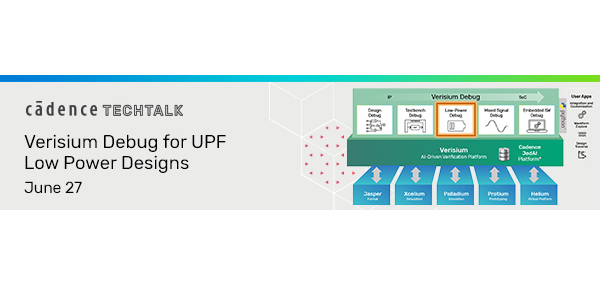
Verisium Debug for UPF Low Power Design
Verisium Debug offers comprehensive debugging capabilities. From RTL, UVM testbench to UPF low-power designs, users can use the Cadence unified debugging platform for debugging. In this webinar, users will learn about the available features in Verisium Debug for UPF power-aware designs and using the unique capabilities to visualize and debug UPF low-power designs. What you…